Software built for pest control operators.
In this trade the invoice is not the only document that matters. What you applied, where, how much and under whose license is a record someone can ask to see.
The application record is included on every plan.
Pest control carries an obligation most field-service trades don't. Every application is a regulated act, and the record of it has to survive long enough for someone official to read it — usually years after the tech who made it moved on.
OrbitOps Pro treats that record as a first-class part of the visit rather than a form bolted onto the end of it. The same action that logs the product for compliance is the one that puts it on the invoice.
The record an inspector can ask for
A shoebox of carbon copies is a record right up until the moment you need to find one specific treatment from three summers ago.
Captured on the visit
What was applied, how much of it, where it went, which pest it targeted and under whose license — recorded by the tech at the property as part of doing the work.
Printed on the invoice
The application detail comes out on the customer's bill, so the homeowner has the same document you do and nobody has to request a copy later.
Included on every plan
Application tracking is on all three plans, deliberately. A compliance document is not a premium capability, and a billing decision should never be able to un-render one.
Requirements vary by state, so check the detail you capture against your own regulator. What OrbitOps Pro guarantees is that the record exists, sits on the property, and can be produced.
Every property on its own cadence
A pest book is rarely one rhythm. Some accounts are monthly, some quarterly, some are commercial and want a Tuesday before opening. The schedule has to absorb all of that without a person rebuilding it.
Set it per property
Monthly, bi-monthly, quarterly or your own interval, defined on the account. One click builds the week for every property due, across every service on that account and including anything carried over — so the recurring book stops needing manual rescheduling.
No drift on a quarterly cadence
Second Tuesday of the month, every three months, means exactly that — this year and next. The cadence math is month-native, so a quarterly or bi-monthly account lands on the same ordinal weekday all year instead of sliding a few days with every cycle.
The day that adds the least driving
For every account still waiting to be scheduled, OrbitOps Pro works out which day absorbs them for the least extra driving and names it before you commit. It is worked out on your own book, so there is no per-lookup cost — and it is choosing the day, not reordering the stops inside it.
The week on paper, before the signal drops
Save offline copy turns the week into a PDF: every scheduled stop, who it is assigned to, and the contact details for the customers on it. If a property sits out of signal, the day still runs off the copy you already saved.
Confirm before the truck rolls
Interior treatments need someone home. Appointment confirmation and appointment mode are both on for pest control, on every plan, so a window is confirmed before it is driven to.
Clustered, then sequenced
Cluster the day's stops by location on any plan. On Executive and Premier, route optimization orders the day and draws it on a map.
Callbacks that don't get lost
A re-service between scheduled treatments is a visit like any other — scheduled, checklisted and recorded against the property, whether or not you charge for it.
The day arrives on the phone, already in order
The office builds the week. The tech opens one screen and works down it — and everything recorded on the way is what the invoice gets built from.
Open it and work down the list
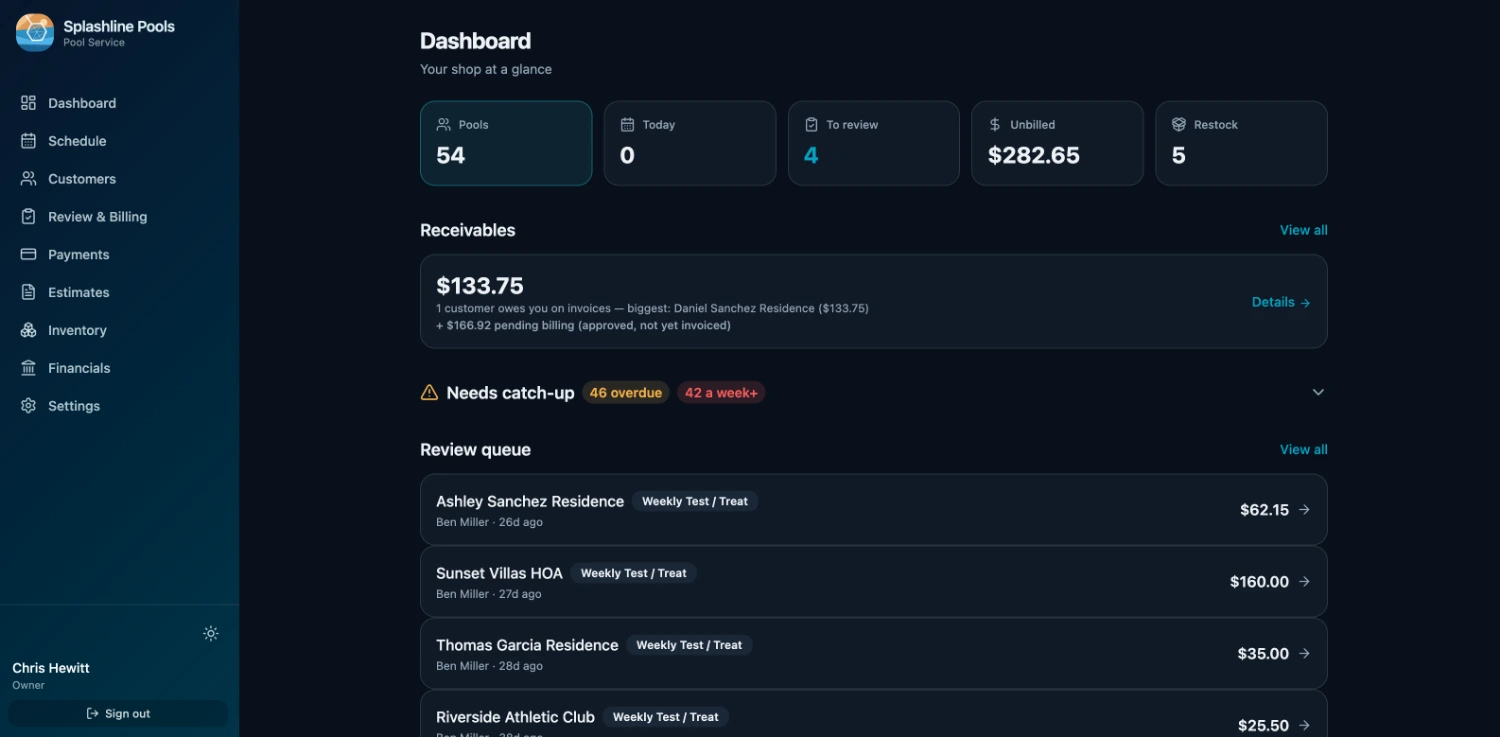
Today opens on the stops in order, each with the customer, the visit type and the address, and a count of how many are done. One tap starts a stop, one opens it in Maps. Nobody is calling the office to ask what is next.
What they record is what you bill
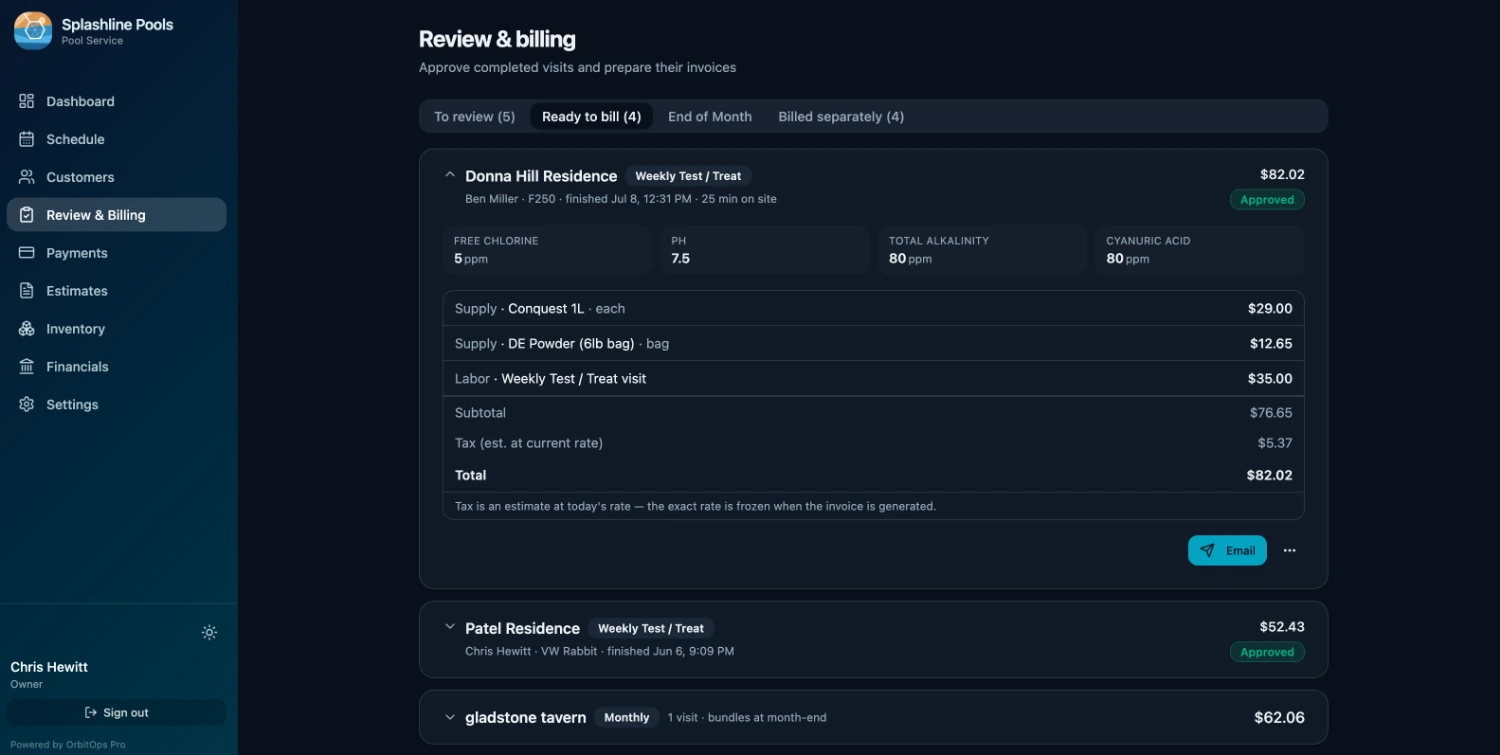
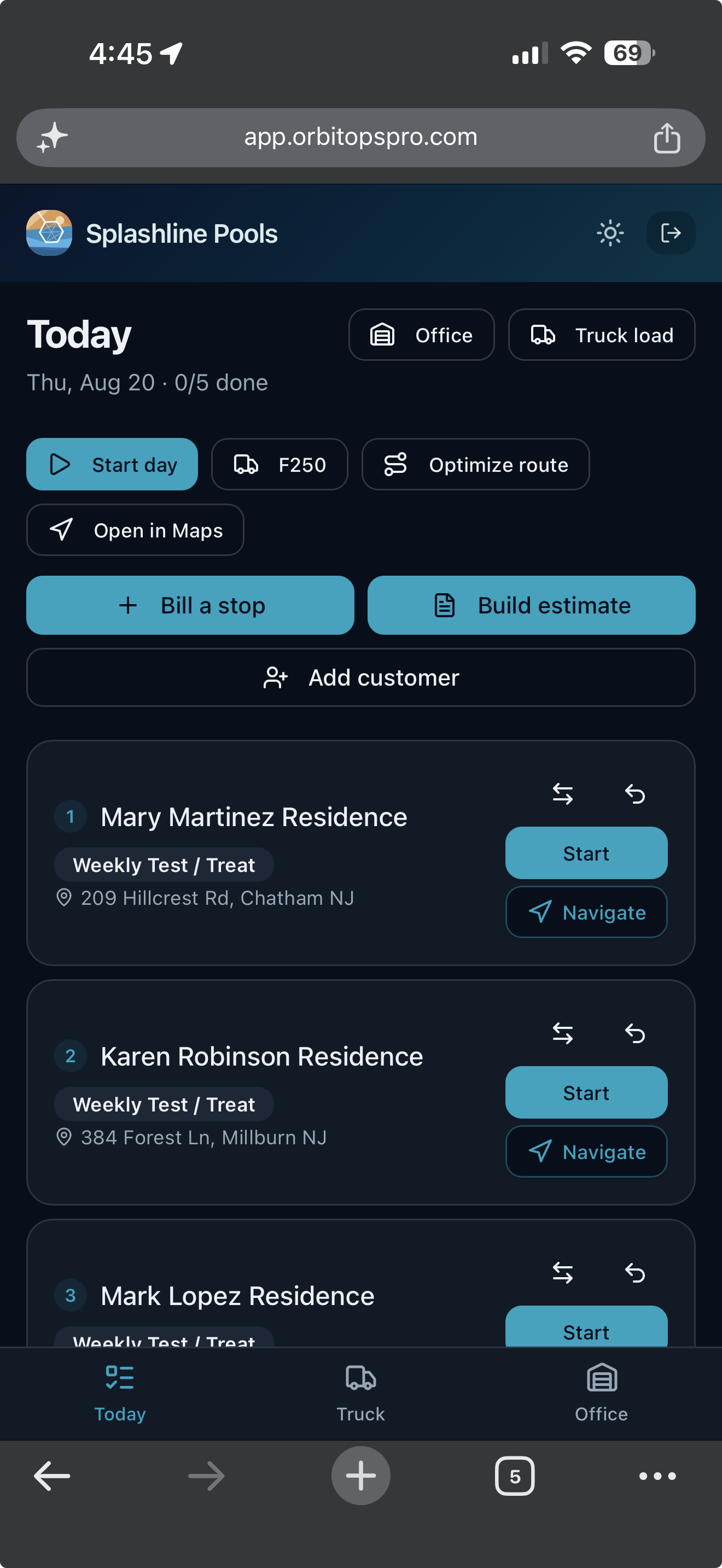
Materials, readings and notes are captured at the stop while the tech is standing in it. The visit record is the billing record, so the invoice is built from what happened rather than reconstructed on Friday.
Billing and quoting from the driveway
A tech you trust can bill a stop as they finish it, and build an estimate while they are standing in front of the work. What they bill in the field is past the month-end sweep’s reach, so the same visit cannot also land on that customer’s monthly bill. The billing grant is per tech and yours to give; estimates come in on Executive.
One action, two obligations: logged and billed
Most operators log the application because they have to, and bill the product from memory because nobody made that easy. The second half is where the margin quietly goes.
The tech logs it once
The product recorded for the compliance entry is the same product that lands on the invoice. There is no second form and no re-typing at the end of the week.
Stock draws down with cost attached
On Executive and Premier, the same entry pulls that quantity out of truck or shelf stock and carries its cost, so you can see what you are holding and what each treatment actually costs to deliver.
Reorder before you're dry
Par levels flag what's short and a purchase order to your supplier brings it back in — the restock loop closes in the same system that raised the flag.
Buy by the case, sell by the piece
On Executive and Premier, one product entry can be bought by the case and sold by the piece. Order a case of bait stations, the tech logs four, and the stock count and the price each move in their own unit — one product record, no mental arithmetic.
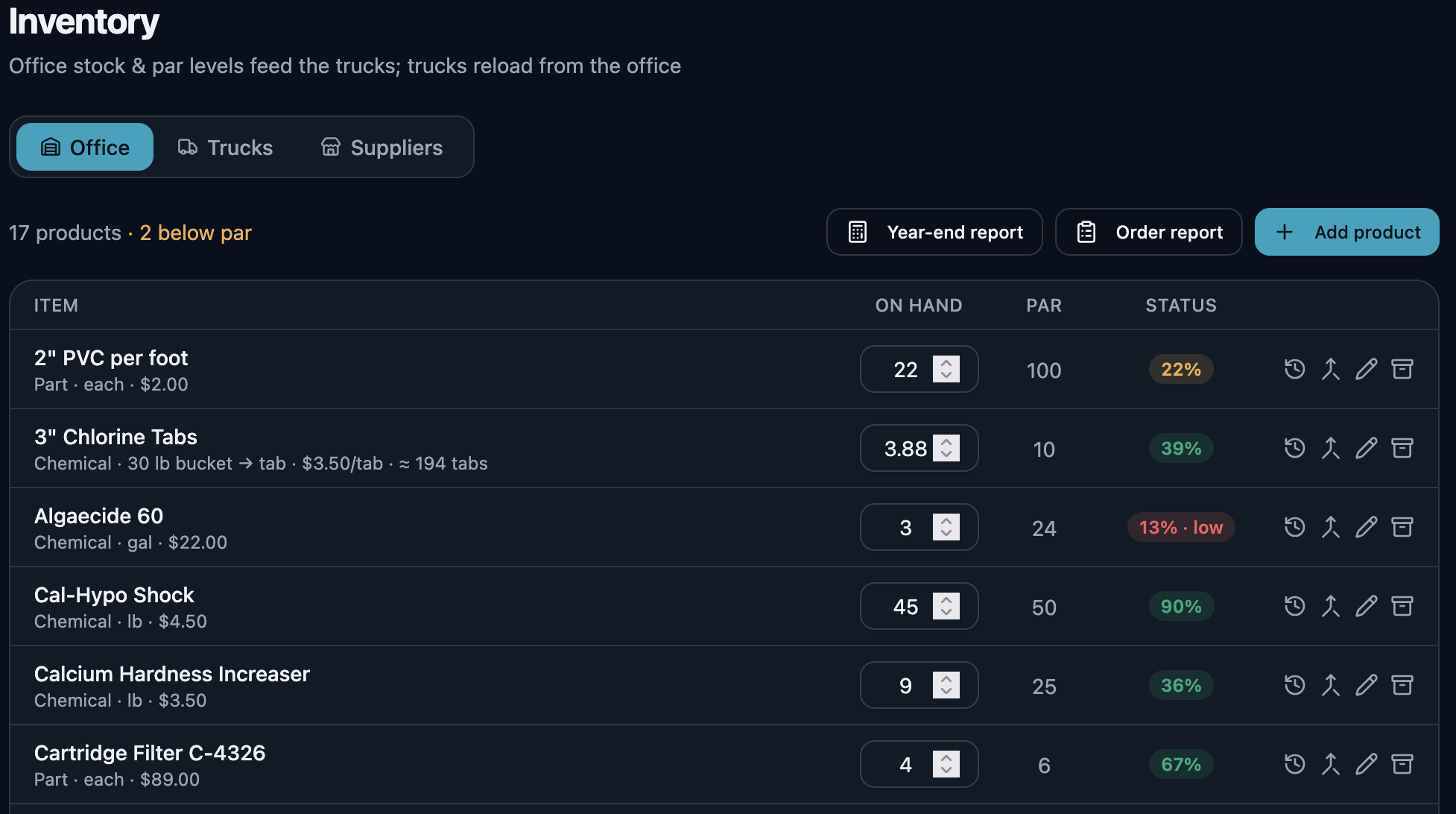
Inventory tracking and purchase orders come in on Executive. On Premier, the money-recovery reports name the accounts that cost more to serve than they bill.
Agreements that know their own terms
Most of a pest book is sold as a plan rather than a job. The question that gets awkward is what exactly a given customer has left on theirs.
Define what you sell
Set up the agreement levels your business offers and what each one includes per term. Available on Premier.
Assigned with a term
A customer gets a level and a mandatory term, so the agreement has a defined start, end and content rather than an understanding.
Included, used, remaining
See what the plan covers, what has been drawn against it and what is still owed — without counting back through a year of visits.
Billed how you sell it
Per treatment as each closes, or a month rolled into one invoice. Both go out with a pay link the customer settles by card, on every plan. Each customer has their own default, set on their record, so the choice is made once for that customer instead of job by job.
What pest operators ask us
Does it keep the application record my state requires?
Application tracking records every product applied on a visit — what it was, how much, where it went, which pest it targeted and under whose license — and prints it on the invoice. It is included on every plan, because a compliance record should not sit behind an upgrade. You should still check it against your own state's specific requirements.
Can I run properties on different cadences?
Yes. Set a cadence per property — monthly, bi-monthly, quarterly or your own — and OrbitOps Pro generates the visits. Each day arrives as a built list. You can cluster the day by location on any plan; on Executive and Premier, route optimization sequences and maps it.
Will the product my techs apply get billed?
On Executive and Premier. The product logged for the application record also becomes an invoice line and draws that quantity down from truck or shelf stock with its cost attached — so the compliance entry and the billing entry are the same action, not two.
Can I sell service agreements?
On Premier. You define the agreement levels you sell and what each includes per term, assign one to a customer with a term, and read off what is included, what has been used and what remains — so a mid-term callback question has an answer.
Can I bill monthly instead of per treatment?
Either, and you can mix them across your book. Bill each treatment as it closes, or roll a month of visits into one invoice. Each customer has their own default, set on their record, so the choice is made once for that customer instead of job by job. Both go out with a pay link the customer settles by card, and both are included in every plan.
Can I confirm appointments before the tech drives out?
Yes, on every plan. Appointment confirmation and appointment mode are both switched on for pest control, so interior work that needs someone home can be confirmed before the truck is committed to the window.
Your customers didn't sign up for our software — you did. Their names, addresses and phone numbers stay in your account. Your books get a month of totals rather than your client list, and our own support console can't display who they are.
What leaves your account →Run your pest control business, not your software.
Create your account and get set up in your trade. Scheduling, invoicing and card payments are included in every plan.
Questions first? Talk to us.
Email support@orbitopspro.com to chat with us.