Software built for septic service operators.
Recurring pump-out schedules, inspections documented, tank and system history per property, and materials billed — OrbitOps runs the septic business from scheduled pump to paid invoice.
Pump-out cadences, inspections, and system history in one system.
Septic service runs on long cadences — a property gets pumped every one to three years — so the hard part isn’t the day, it’s never losing track of when each tank is due. Add inspections, repairs and the materials each job uses, and it’s a lot to hold in a spreadsheet.
OrbitOps keeps every property on its pump-out cadence, documents inspections against the system, and lets techs log materials on the job so the invoice reflects the real work — billed per job or on a monthly account.
Everything the property runs on — in one place
Scheduling, invoicing, payments and materials, described in the way septic service actually works — from booked to paid.
Recurring pump-out schedules
Set each property’s pump-out cadence — annual, every two or three years — and OrbitOps surfaces what’s due and routes the day, so tanks get serviced on time instead of slipping off the radar.
The week on paper, before the signal drops
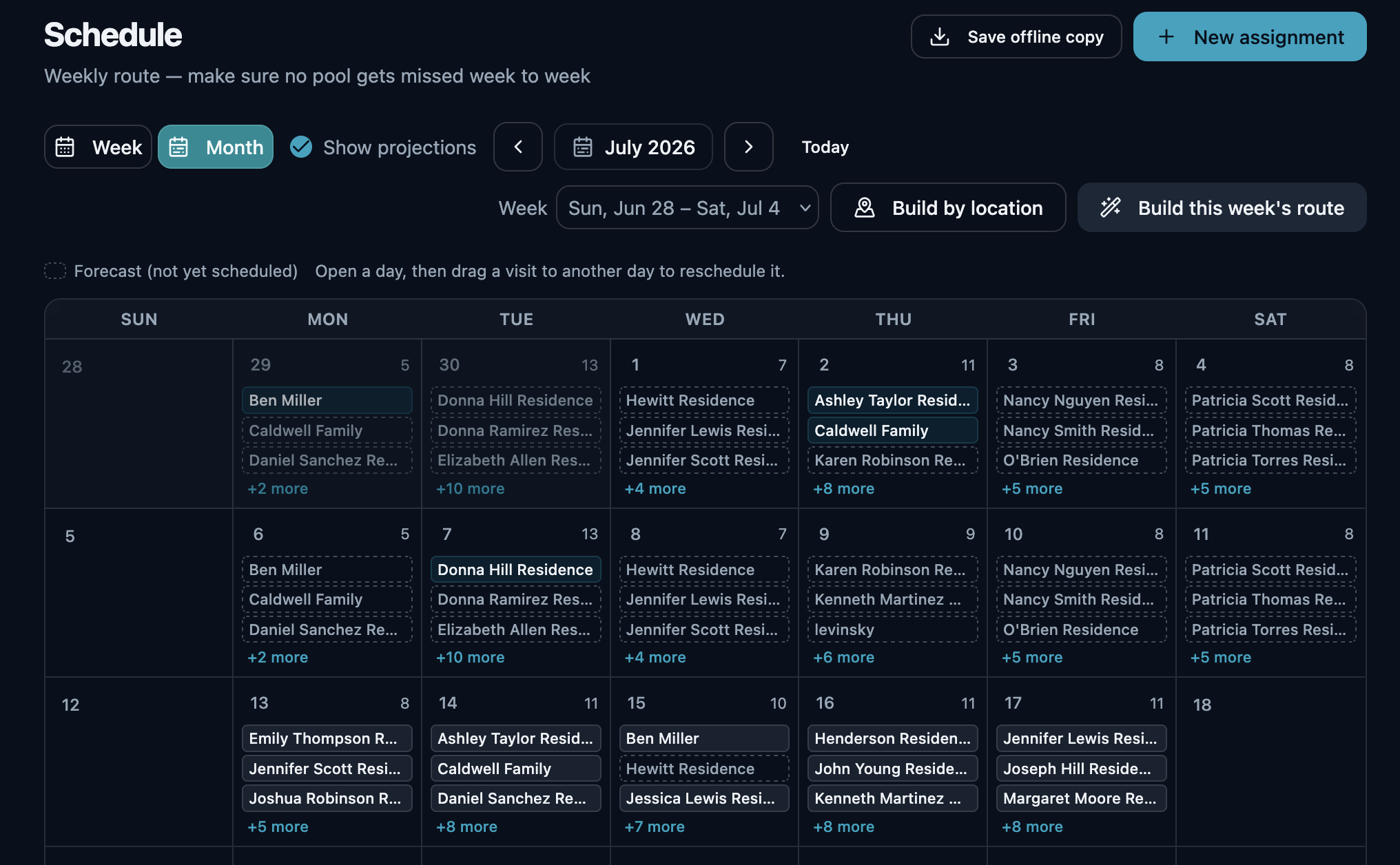
Save offline copy turns the week into a PDF: every scheduled stop, who it is assigned to, and the contact details for the customers on it. If a property sits out of signal, the day still runs off the copy you already saved.
Per-job or monthly invoicing
Bill each pump-out, inspection or repair as it closes, or run commercial accounts on a monthly invoice. The job checklist becomes the invoice. Each customer has their own default, set on their record, so the choice is made once for that customer instead of job by job.
Get paid on completion
Send a pay link as the pump-out closes — the customer pays by card on Stripe’s hosted checkout and funds settle into your own Stripe account. Cash and checks get recorded against the same invoice.
Tank & system history per property
Every pump-out, inspection and repair stays on the property’s system record — tank size, condition, findings — so the next visit and the next inspection start informed.
The day arrives on the phone, already in order
The office builds the week. The tech opens one screen and works down it — and everything recorded on the way is what the invoice gets built from.
Open it and work down the list
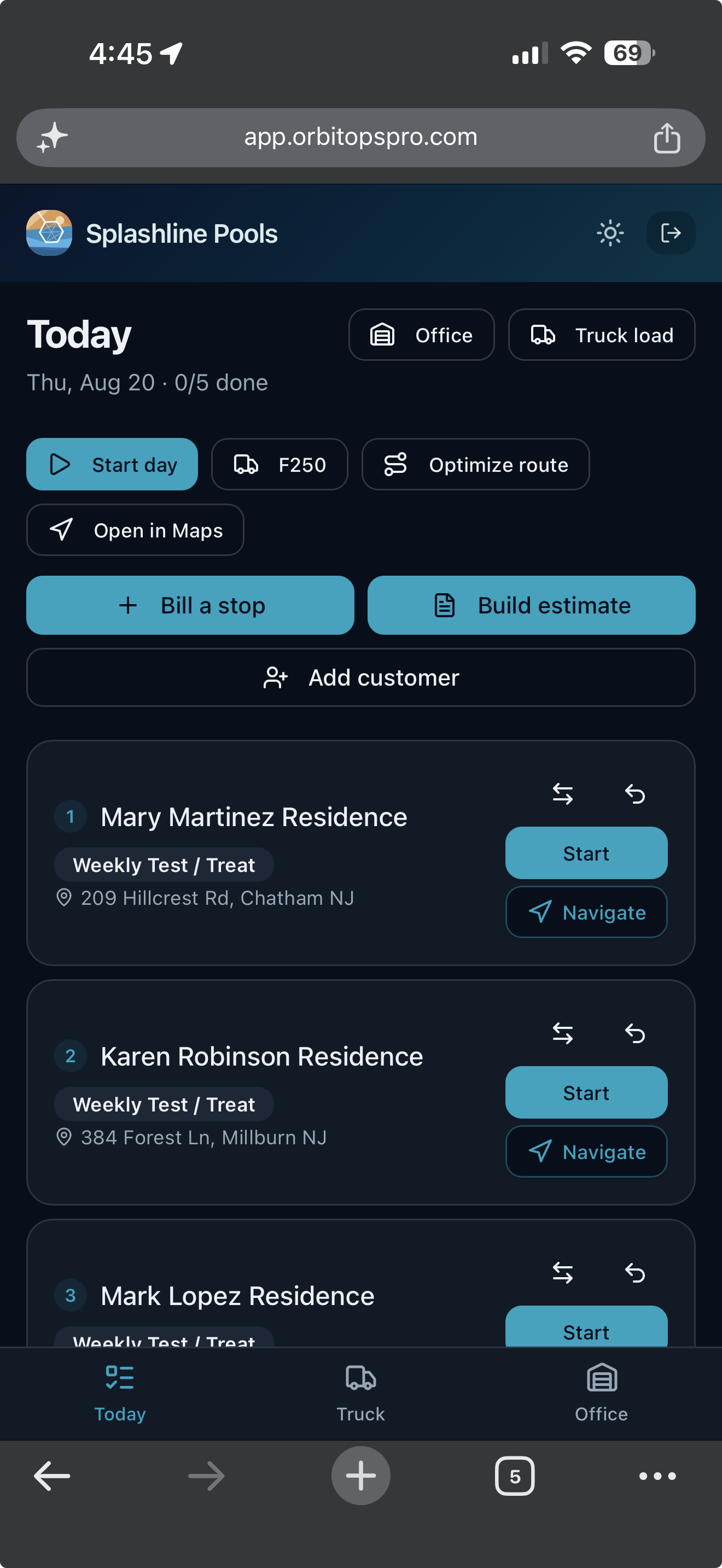
Today opens on the stops in order, each with the customer, the visit type and the address, and a count of how many are done. One tap starts a stop, one opens it in Maps. Nobody is calling the office to ask what is next.
What they record is what you bill
Materials, readings and notes are captured at the stop while the tech is standing in it. The visit record is the billing record, so the invoice is built from what happened rather than reconstructed on Friday.
Billing and quoting from the driveway
A tech you trust can bill a stop as they finish it, and build an estimate while they are standing in front of the work. What they bill in the field is past the month-end sweep’s reach, so the same visit cannot also land on that customer’s monthly bill. The billing grant is per tech and yours to give; estimates come in on Executive.
The materials you don’t bill are profit down the tank.
Risers, lids, filters, baffles, additives — septic jobs use materials beyond the pump. Log them on the visit and they land on the invoice. Reconstruct them later and the ones you forget are margin, gone.
Techs log what they use, on the visit
Risers, filters, baffles and additives get recorded on the tech's checklist while they're on site — not reconstructed from memory at the end of the week.
Used becomes billed, automatically
Whatever went onto the job flows straight onto the invoice as a line item. The checklist is the billing record. One action, both records: the visit log and the invoice line.
See what’s stocked on each truck, and what it's worth
On Executive and Premier, every logged item draws down truck and shelf stock in real time, with cost attached — so you know what you're holding, what it's worth, and when to reorder.
Scheduling tools that ignore materials bill the pump-out and eat the rest. OrbitOps captures both — because what comes off the truck goes on the bill.
See what each plan includesSeptic Service software questions, answered
Can it schedule recurring pump-outs on long cadences?
Yes. Set each property’s cadence — every one, two or three years — and OrbitOps tracks what’s due and routes the day, so tanks that only come up occasionally never fall off the schedule.
Does it document inspections?
Yes. Inspection is a built-in visit type with a checklist to record findings against the property, so every inspection stays on the property record instead of a paper folder.
Will it track the system per property?
Yes. Each property carries its full visit history — past pump-outs, inspections and repairs — so every visit begins with the record of what has already been done there.
Your customers didn't sign up for our software — you did. Their names, addresses and phone numbers stay in your account. Your books get a month of totals rather than your client list, and our own support console can't display who they are.
What leaves your account →Run your septic service business, not your software.
Create your account and get set up in your trade. Scheduling, invoicing and card payments are included in every plan.
Questions first? Talk to us.
Email support@orbitopspro.com to chat with us.