Software built for plumbers, not enterprise fleets.
Service calls, estimates that become jobs, parts logged at the property, and invoices out the door before you’ve left the driveway — OrbitOps runs the plumbing business from first call to paid.
Estimates, jobs, parts and payments in one system built for the truck.
Plumbing runs on two clocks: getting a truck to the property fast, and getting paid for every valve, fitting and fixture that goes into the job. When parts get scribbled on a work order and typed up days later, the ones that get forgotten are pure margin gone.
OrbitOps books the service call, turns your estimate into a scheduled job, and lets the plumber log parts at the property so the invoice is built by the time the work is done — per job, or on a monthly invoice for property managers.
Everything the property runs on — in one place
Scheduling, invoicing, payments and materials, described in the way plumbing actually works — from booked to paid.
Dispatch & route the day
Book service calls in seconds and group the day’s stops by location, on any plan, so your plumbers work one area at a time. On Executive and Premier, route optimization sequences the day by drive time and draws it on a map. Emergency call comes in? Slot it and resequence.
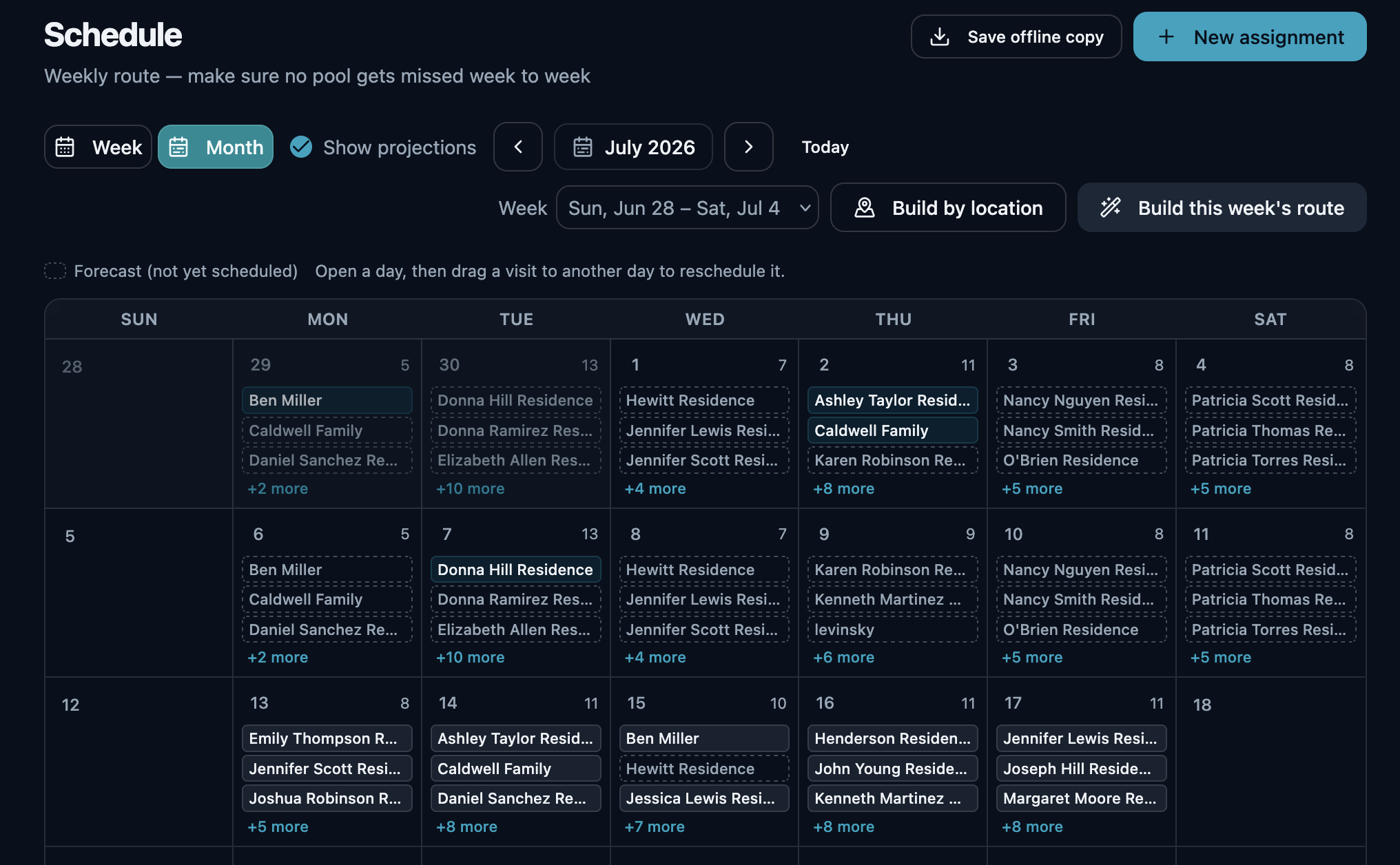
The week on paper, before the signal drops
Save offline copy turns the week into a PDF: every scheduled job, who it is assigned to, and the contact details for the customers on it. If a phone dies on a job, the day still runs off the copy you already saved.
Estimates that turn into jobs — and invoices
On Executive and Premier, quote the work and an approved estimate converts straight into a scheduled job. When it’s done, the job is the invoice — bill per job or monthly for repeat commercial accounts.
What the job actually took
On Executive and Premier, the approved estimate runs the job, and whatever the tech adds on site is captured against it as a marked overage. The extra valve fitted at four o’clock shows on the bill as an addition to what was quoted, instead of disappearing between the estimate and the invoice.
Get paid at the property
Send a pay link the customer taps before you’ve packed the van — they pay by card on Stripe’s hosted checkout and funds settle into your own Stripe account. Cash and checks get recorded against the same invoice.
Property & job history that sticks
Every job, part and note stays on the property record — so the next call, whether it’s you or another tech, starts with the full picture instead of a cold read.
The day arrives on the phone, already in order
The office builds the week. The tech opens one screen and works down it — and everything recorded on the way is what the invoice gets built from.
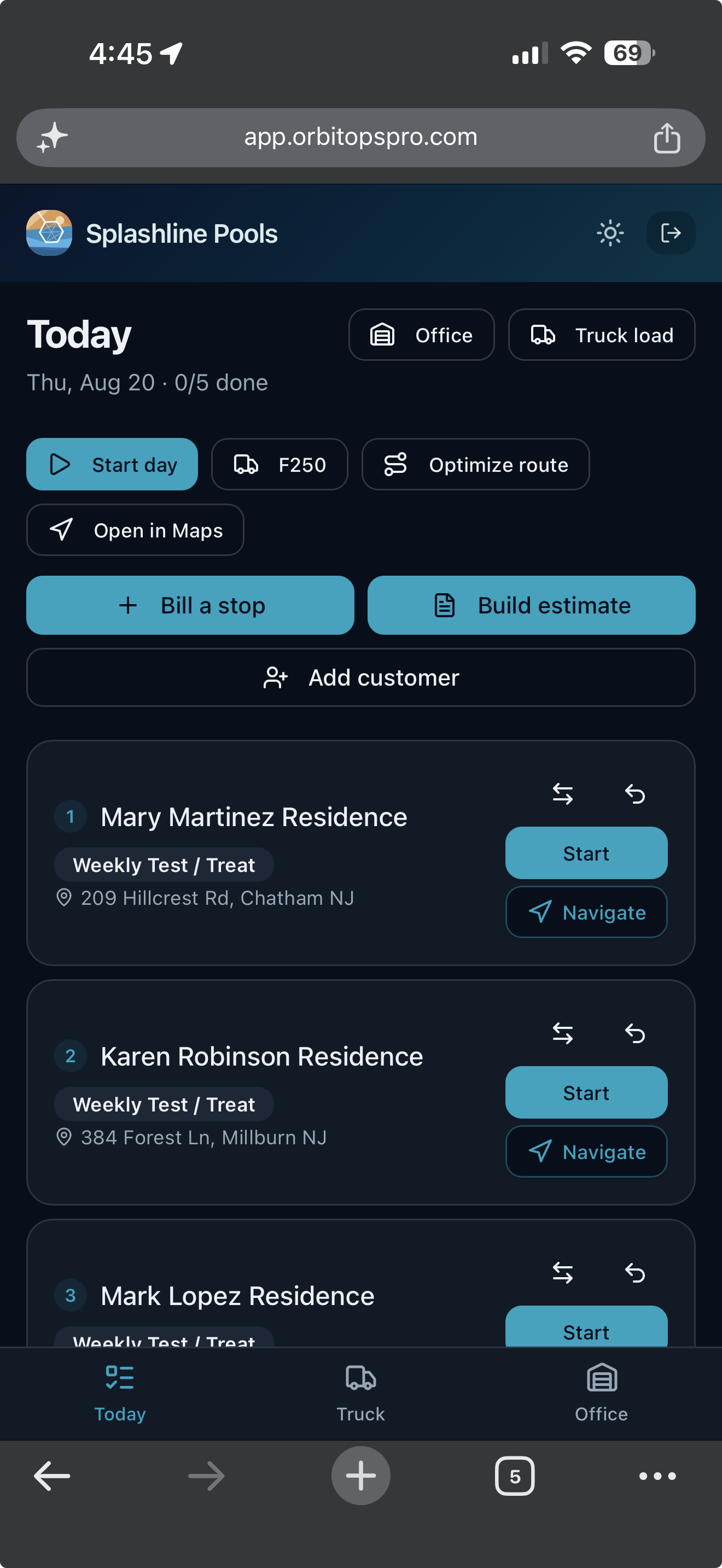
Open it and work down the list
Today opens on the stops in order, each with the customer, the visit type and the address, and a count of how many are done. One tap starts a stop, one opens it in Maps. Nobody is calling the office to ask what is next.
What they record is what you bill
Materials, readings and notes are captured at the stop while the tech is standing in it. The visit record is the billing record, so the invoice is built from what happened rather than reconstructed on Friday.
Billing and quoting from the driveway
A tech you trust can bill a stop as they finish it, and build an estimate while they are standing in front of the work. What they bill in the field is past the month-end sweep’s reach, so the same visit cannot also land on that customer’s monthly bill. The billing grant is per tech and yours to give; estimates come in on Executive.
Every fitting you don’t bill is profit left at the property.
Valves, fittings, supply lines, a water heater, a fixture — a plumbing job eats parts. Log them as the plumber works and they land on the invoice. Reconstruct them from memory later and the forgotten ones are gone for good.
Techs log what they use, on the visit
Fittings, valves, fixtures and water heaters get recorded on the tech's checklist while they're on site — not reconstructed from memory at the end of the week.
Used becomes billed, automatically
Whatever went onto the job flows straight onto the invoice as a line item. The checklist is the billing record. One action, both records: the visit log and the invoice line.
See what’s on every truck, and what it's worth
On Executive and Premier, every logged item draws down truck and shelf stock in real time, with cost attached — so you know what you're holding, what it's worth, and when to reorder.
Reorder what’s short, in whole packs
On Executive and Premier, the reorder report shows what has fallen below par and rounds each shortfall up to whole orderable packs, then emails the purchase order to your supplier. The order you sent is kept as a fixed snapshot, and your own costs stay off the supplier’s copy.
Buy by the case, sell by the piece
On Executive and Premier, one product entry can be bought by the case and sold by the piece. Order a case of twenty-four couplings, the tech logs two, and the stock count and the price each move in their own unit — one product record, no mental arithmetic.
Most plumbing tools bolt inventory on as an afterthought. OrbitOps makes the parts list part of the job — because what comes off the truck goes on the bill.
See what each plan includesPlumbing software questions, answered
Can I turn an estimate into a scheduled job?
Yes, on Executive and Premier. Quote the work as an estimate; once the customer approves it, it converts into a scheduled job on the board with the line items carried over — no re-keying. When the job closes, those line items are the invoice.
What happens when the job grows once we’re on site?
On Executive and Premier, the approved estimate runs the job, and whatever the tech adds on site is captured against it as a marked overage. The extra valve fitted at four o’clock shows on the bill as an addition to what was quoted, instead of disappearing between the estimate and the invoice.
Does it bill the parts my plumbers install?
On Executive and Premier. Plumbers log fittings, valves, fixtures and materials on the job as they work, and each becomes an invoice line item that also draws down truck stock. The parts you install get charged for, automatically.
Does it track the parts on each truck?
On Executive and Premier. Every item a plumber logs draws down truck and shelf stock in real time, with cost attached, so you know what you’re holding, what it’s worth, and when to reorder. The reorder report shows what has fallen below par, rounds each shortfall up to whole orderable packs, and emails the purchase order to your supplier.
Can a plumber take payment at the property?
Yes, and card payments are on every plan. Send a pay link the customer taps before you’ve packed the van — they pay by card on Stripe’s hosted checkout and funds settle into your own Stripe account, and cash and checks get recorded against the same invoice. A tech you trust can bill the stop as they finish it; the billing grant is per tech and yours to give.
Can I bill property managers monthly instead of per job?
Yes. Bill each job as it closes, or compile a month of jobs at a property into one monthly invoice — useful for property-management and commercial accounts that want a single invoice. Each customer has their own default, set on their record, so the choice is made once for that customer instead of job by job.
Your customers didn't sign up for our software — you did. Their names, addresses and phone numbers stay in your account. Your books get a month of totals rather than your client list, and our own support console can't display who they are.
What leaves your account →Run your plumbing business, not your software.
Create your account and get set up in your trade. Scheduling, invoicing and card payments are included in every plan.
Questions first? Talk to us.
Email support@orbitopspro.com to chat with us.